- Shocking news article accusing one politician of something bad
- A “Here, Here” agreement with a call for resignation, court-martial, imprisonment, or impeachment
- The article is dismissed as being “taken out of context” or “a pack of lies”
- The author of the article is accused of bias
- The author is attacked on a personal level (“He’s a fat slob”)
- Someone quotes the dictionary
- Someone brings up some wrongdoing (real or perceived) of a politician from the opposing party, arguing “at least he’s not as bad as this guy”
- Someone copies and pastes a 5 page op-ed piece into the thread
- Someone starts a rebuttal with the word “Fact:”
- An ominous quote is cited. Bonus points if it’s by George Orwell or Hermann G
Month: August 2004
General Zuo’s Rooster
Intrepid ABC reporter heads to China to uncover the origins of General Tso’s Chicken, a so-called Chinese dish served in North America that Caucasians love and Chinese have no clue what on earth it is.
It turns out that Cantonese, Hunan and Sichuan immigrants brought their peasant dishes to the New World, where it evolved into what you see today. General Tso’s Chicken has as much in common with Chinese cuisine as Pizza Hut has with Italian cooking.
Real Chinese food is nothing like what you see at Mandarin or Ho-Lee-Chow’s (geddit?). It’s like walking into an “English” restaurant that served nothing but casserole and chipped beef on toast.
Stir fry and fried rice is what you make with day-old leftovers. Egg Foo Young is just a cheap meal for college students. In real Chinese cuisine, nothing is deep fried in batter, or drowned in a thick, iridescent red sauce.
And you certainly don’t get a fortune cookie at the end.
Intellectual cold war
Like most companies with a clue these days, Microsoft is filing patents. And why not, it’s essentially free money, plus you build up a defensive litigation portfolio. Microsoft has filed over 2,000 patents for consideration in 2004, and plan to break that record in 2005. New York Times points out that Microsoft patents are cited as prior art “in other patent filings somewhat more often than the patents of other technology companies,” including patent-lovin’ IBM.
Patently Obvious points out that MS employs 29 patent attorneys and 2 patent agents – a respectable amount of IP firepower.
All these filings have got the open source crowd a bit worried, as patents can be used defensively and offensively. Open Source Risk Management LLC gathers that, while there are no court-tested patents that could be used against Linux, there are 283 untested patents – 60 of them owned by IBM, 27 of them owned by MS – could possibly be used to sue Linux developers. OSRM does urge calm: “It’s very similar to the result you would get if you investigated any other software program that’s as successful.”
This does suggest that for Linux to avoid death by patent lawsuit in the future, it should also stockpile its own patents. Dan Ravicher, a patent attorney that works for OSRM and the Public Patent Foundation, does point out that nearly half of all patent infringement suits are won in favour of the defendants, making legal challenges against Linux quite risky. So maybe the best course of action is to get some legal advice, but keep churning out that code.
Theory of establishment
If you see a pawnshop, church and karate dojo in close vicinity, it’s a bad neighbourhood. If you see a furniture store, Buddhist temple and yoga studio, it’s a good neighbourhood.
Get the facts on the facts
Microsoft doesn’t want you to defect to Linux. However, instead of pointing out Windows’s obvious strengths, they have decided to harp about total cost of ownership, a metric that is debateable and non-consistent at best. It doesn’t help that their proof – in the form of Microsoft-funded studies – seem to be stacking the deck in MS’s favour. Take this excerpt from a Microsoft “Get The Facts” anti-Linux advertisement seen in InfoWorld:
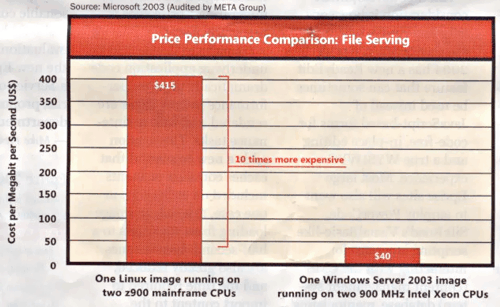
Wow. Imagine that. A mainframe costs more to purchase and maintain than a personal computer.
As always, the best way to check the validity of any claim is to ask questions. ZDNet UK has offered some helpful questions to Microsoft salespeople to give them the chance to clarify their statements. My favourite:
“Why shouldn’t I replace Microsoft Office with Open Office, or Internet Explorer with Mozilla? Won’t this work as an excellent first step towards full-scale open source deployment, given Microsoft’s commitment to openness and interoperability?”
Even the so-called “success stories” should be scrutinized. ZDNet points out that at least one organization that chose Windows over Linux because MS appeared cheaper, the London borough of Newham, may have in fact been offered an “uncharacteristically generous package, including a substantial amount of free consultancy, to sweeten the deal.”
“We’re winning, people.”
That’s what the outspoken Eric Raymond concluded as he dissected Microsoft’s latest Get the Facts marketing push. “Microsoft has failed to stop us with better software technology or lower prices; they’re incapable of the former and their business model wouldn’t survive the latter.” Raymond dismisses Get the Facts as mere “semantic warfare” and “an obvious circle the wagons move”.
Certainly no one product, Windows or Linux, is the be all that ends all. However, methinks that if your product is truly superior, there is no need to belittle the competition. Fight with facts, not with mud.
Real life is just another window
CNN reports where the Internet-enabled, laptop-toting children of today, the Generation I if you will, have made technology as indispensible extensions of themselves. Nothing new here: Marshall McLuhan postulated that computers would amplify humanistic intelligence, in the same way that sliderules and calculators augment our mathematic skills.
Steve Mann of the University of Toronto took the extension theory to its logical extreme by augmenting himself with a series of wearable computers and cameras that allow him to interact with and record his surroundings.
As usual, the kids figured it out first. The computer isn’t just a grey box in the living room for surfing eBay: it’s a familiar that connects and enriches their very lives.
Where information is free and readily available, it has increasingly become a world where it’s not what you know, but where to find it, how to interpret it, and who to talk to. The ability to forge relationships (both in the causal and social sense) becomes even more precious.
A jolly rogering
When I moved back to Toronto, I discovered I wasn’t allowed to stick my ExpressVu satellite dish on the building, so I had no choice but to obtain my television from our local cable monopolist, Rogers Cable.
Because we are such a valued customers, Rogers has awarded us by putting me on their email spam list. Every month I get sales pitches for the latest Rogers whatzit. And what happens when you click on “unsubscribe”?

Well, you have to fill out a giant form plus urine sample and signed letter from the Queen to get removed off the list. All fields are required to be filled in. Oh yeah, your wireless cellphone number is also a required field, so, you know, Rogers can be extra extra sure that you are you and they’ll never stick you on their telemarketing list, cross their hearts and hope to die.
The funny is, after sending off this form (I put down a fake phone #), I am still getting the Rogers spam newsletter.