Take me by the hand, take me somewhere new

This is interesting: Bell Sympatico and Mobility teamed up to provide coverage to Avril Lavigne’s mall tour. The interesting part is, all photo coverage was provided by Mobility via their flagship camera phones, Samsung A600s. Sympatico posted them all on Buzznet, a moblogging site.

This comes as a bit of a surprise to me, since Bell Canada has always been obsessed with order process approvals and workflow management. In other words, they’re the type of corp that you’d think would least likely make a blog. It’s risky, especially considering the number of comment flames you’ll read on Buzznet. Glad to see there’s a few forward-looking folks in Bell Mobility.

As an aside, this is a good example of how Sympatico.ca is leveraging BCE’s media abilities to provide exclusive video and photo content to Sympatico subscribers. In a crowded Canadian market of cheaper, commoditized reseller ISPs, Sympatico is trying to make itself stand out from the crowd. Let’s see if it works.

Trivia: Avril’s dad works at Bell Canada.

Putting a bounty on a problem

Continuing on the theme of collaborative problem solving, Fortune’s David Kilpatrick highlights the achievements of InnoCentive. The article is for Fortune subscribers only, but I’ll fill in the blanks.

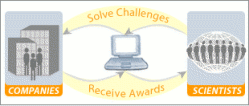
As most computer geeks know, if you’ve got a question or a problem to solve, the quickest way to an answer is to ask online. innocentivegraphic.gifInnoCentive, spun off by Eli Lilly as a new, cost-effective way of solving generic scientific problems for companies, just formalized this concept. Instead of using their own precious R&D resources, they can use InnoCentive as a go-between to anonymously post problems and cash prizes to to a global community of scientists.

Cash prizes range from $10,000 to $100,000 USD. IP ownership remains with the sponsoring company.

InnoCentive should accelerate innovation even as it lowers costs for companies and ultimately prices for consumers. (One seeker has found that this process delivers six times the ROI of conventional R&D.)…As the offshoring controversy has underscored, these days it matters less where you live than whether you have the talent and knowledge people want. Says Alph Bingham, the Lilly executive who thought up InnoCentive: “There is a whole world of smart people out there.”

It’s a radical way of doing business; it’s something that wouldn’t even be possible without the global reach of the Internet. As the Internet is applied as a bonafide social network capable of creating far-reaching communities on the fly, endeavours such as InnoCentive may soon become the norm.

Caught in a landslide, no escape from reality

Here’s an interesting initiative that popped up on my radar screen lately: Project Avalanche, a quasi-open source co-op. For a $30,000 yearly subscription, corporate members can donate their in-house software (including source code) and gain access to other member companies’ donated software for free.

Update: Ed Sims points out some other alternatives in the emerging collaborative development business.

Who’s in on it
Current subscribers include Best Buy, Medtronic and Cargill. The list is still currently pretty short.

The low-down
“Why were they writing such big checks to their software companies, but getting so little in return? Why were their in-house programming staffs writing the same sorts of custom programs written at thousands of other companies? If Detroit car makers can collaborate on research, why couldn’t U.S. technology users?”

Benefits

  • Increase knowledge reuse
  • Save money (20% to 40% according to their TCO studies)
  • Independence and autonomy from software vendors

If these sound a lot like benefits of open source, you’re right.

IP Ownership
“Members of the Cooperative share intellectual property (IP) and collaborate on projects that generate IP.” Apparently it’s also legally binding.

Do you have to donate software?
Not required. Companies are free to donate whatever they want, if they want. Benefits include:

  • production-harden their IP and software (free testing)
  • encourage further innovation and improvements
  • lower maintenance costs

If these sound a lot like benefits of open source, you’re right again.

What makes this “cooperative source” different from open source?
It’s an open source gated community. Innovation and collaboration will not as great as if these companies released their software under a public license, due to a much smaller set of participants.

Avalanche does claim that cooperative source has the added advantages of “oversight, shared financial risk, increased control, greater safety and security for corporations.” Is this worth $30,000? Avalanche thinks so.

One other big plus is the fact the software library is targeted toward enterprise-level apps – applications that typically are not open source projects.
Good technology

I’ve never heard of Stephen Downes, but he’s awfully clever. Robin Good posts an excerpt from his unpublished book, “The Learning Marketplace: Meaning, Metadata and Content Syndication in the Learning Object Economy” the Nine Rules for Good Technology – and damn fine good ones at that.

Good technology:

  1. Is always available. Availability strongly depends on price, but not overly so. Example: ATMs.
  2. Is always on, or can be turned on with a single command. Examples: Telephones, broadband internet access.
  3. Is always connected. And will transfer data to where it is needed, automatically. Example: GPS.
  4. Is standardized. Standardization guarantees interoperability. Example: W3C’s HTML spec allows anyone in the world with a web-enabled device to see your website.
  5. Is simple. When he talks about simple tech, he means it’s intuitive. Example: An insulin pen is simpler to use than a syringe; a diabetic just unscrews the cap and jabs.
  6. Does not require parts. “Perhaps even good technologies, such as portable stereos that require CD-ROMs, need parts. But a portable stereo that does not need CD-ROMs because it can download MP3s from the Internet would be better.”
  7. Is personalized. Technology should customize itself to fit your needs. Example: adjustable foot pedals on the Ford Taurus.
  8. Is modular. Technology should consist of independent entities that can be arranged into a desired configuration with minimal effort. Example: The Linux kernel allows it to be the brains inside TiVo players and Volvo automobiles alike.
  9. Does What You Want It To Do. Good technology is idiot-proof, robust and just damn works.

A VC points out a interview with Clay Shirky where Clay sums this up by stating that good technology is that which gives its users freedom of choice. “Microsoft gears up the global publicity machine its launch of Windows 98,” Clay says, “and at the same time a 19 year old kid procrastinating on his CS homework invents a way to trade MP3 files. Guess which software spread faster, and changed people’s lives more?”

Which is the core benefit of open source software – users are given autonomy from vendors and are empowered to choose, share and alter their software as they see fit.

Aside: Be sure to read that interview at the Gothamist. Clay is one of the most endearing and fascinating interview subjects I’ve ever read about.

In the end, good technology is so good, using it is second nature: “I was coming home in a cab from LGA in the pouring rain a few months ago, and sliding through a pool of water, we rear-ended the cab ahead of us. Both drivers got out, furious, and, before saying a word to one another, took out their phones and photographed each other’s license plates.”

The killer app

Having come from hearing the Senior VP of Technology speak to us a few days ago, it hit me; in the IP world, voice is just an application.

People crow how VoIP first-movers such as Vonage and Primus TalkBroadband are going to be the “Bell killers”. That isn’t the point.

The thinking has always been that a POTS customer is a more profitable one. Wrong. If you don’t provide a more valuable service, you will lose your customers. POTS and long distance were great cash cows, but they’ve become commoditized. The real money lies in providing enhanced services via the IP infrastructure.

Salon’s article, Triumph of the telcos, is just stating the obvious. At least the telcos in Canada are not standing idly by; they’ve spent the last five years developing QoS-enabled IP networks to support a variety of IP applications – and in real-time if needed. In Bell Canada, for example, is harnessing Cisco’s MPLS technology and Nortel’s softswitch expertise for their Next Generation Network initiative.

This is a serious ocean-boiling maneuvre. Remember, it’s not a disruptive technology if everyone’s in on it. Bell will still be making money, both on the wholesale and retail sides.

Om Malik downplays the telco’s mettle, stating a price war is imminent. That’s true: The first-movers currently offer a crude VoIP over broadband arrangement that offers no guarantee of service, nor service during blackouts. They have decided to compete on price instead; Primus’s offering is a roughly $3 to $5 less per month than the ol’ trusty rusty PSTN.

But voice is just an ever-shrinking piece of the pie. Can you imagine checking your home voicemail from a wireless PDA, or receiving Caller ID on your television? How about having phone, Internet and TV services streamed to your home from a single Ethernet jack? That is the future. That is what Canadian telcos are striving for.

Is it obvious? Is it novel?

Patents: do they encourage or discourage innovation? Dare Obasanjo offers a low-level perspective: you might as well file, since “there is a lot of incentive to file patents for software innovations if you work for a company that can afford to do so. However the measure of degree of innovation is in the eye of the beholder [and up to prior art searches].”

The problem with patenting software in my mind, is that most of the stuff that’s been patented is fairly obvious. Of course, “obvious” is a subjective term – something that seems to go without saying to one person can be considered ingenious to another. Typically, as the folks in Law attest, the inventor is often too close to his/her invention to subjectively gauge how “obvious” their innovation is.

Software patents especially vex the free software community, because to them they’re seeing common public algorithms being snatched up by private individuals or organizations. It goes against the open source philosophy of commoditizing software.

Call it “patent squatting.” The worst kind of patent owners are the kind who patent everything in sight then start charging people for what was originally free, and then sue those who don’t pay up. It happens more often than you think. Lawyers and patent agents are not always proper barriers; they may lack the technical saavy to smell a rat.

After the whole “eBay patenting the one-click buying method” debacle a few years back, Jeff Bezos presented an open letter call for patent reforms to limit the amount of time to file and keep a patent.

Some changes are now underway, although naturally some entrepreneurs are objecting to certain reforms.

Converging towards the mind

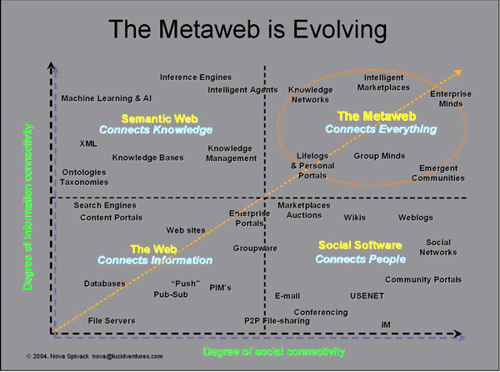
Knowledge management consists of two key components: codification, and personalization. Codification is the act of amassing and archiving data and information. In this day and age, that means digitalization, databases and search engines. Personalization is the act of spreading knowledge through communication – email, blogging, wikis, plain ol’ social networking.

Nova Spivacks sees a near future where these two worlds will converge into a phenomenon he coins the “Metaweb”. Information will increasingly rich in content. With the inroads e-paper is making, one can conceivably have an interactive, immersive newspaper, or a televised videocast that can be observed from multiple angles and multiple personal perspectives.

Other products Spivack predicts are personal portals or “lifelogs” that record ones personal life experiences (leave it to Microsoft Research to be already working on this one in the form of the SenseCam).

Unified communications with persistent relationship management will be the norm (the Holy Grail, Universal Personal Telecommunications: one person, one phone number).

Corporate collaborative KM tools will also be so sophisticated, they function like a group mind. Other predicted creations are intelligent marketplaces (the descendants of eBay and Expedia) and decentralized, emergent communities (a higher form of today’s social software?).

metaweb_graph.png
Chart by Nova Spivack

Indifferent to Instant Messaging

The primary reason companies don’t like IM is because most managers see it as yet another distraction from “real” work. If you think about it, it makes sense. When they come home, what do they see? Their teenage kids yammering away on AIM or ICQ.

Unlike telephones or email, the early adopter of IM (and blogs, wikis and SMS “texting” for that matter) was the Internet-saavy Generation Y. Ergo, for many businesspeople, IM = idle chitchat.

The second reason is a company’s obsession with controlling communication. I remember talking to the president of a small firm a few years ago about upgrading his single 56K Internet connection that was struggling to serve over ten employees. His response? The 56K stays: all the better to keep staff off eBay or career sites. In the same way, managers don’t trust IM.

The third reason is plain computer ineptitude. Most workers can barely use email and Office. It doesn’t help that instant messengers are often have very non-standard GUIs compared to typical Windows apps; it still throws my mom in a loop that she has to double-click the ICQ icon in the system tray to open the contact list, while all other programs are only one click away on the TaskBar.

My company used to employ Lotus Sametime, but that effort faded from lack of use. A new initiative has sprung up, this time using Windows Messenger and MS Live Communication Server. This way, employees can talk to each other within the encrypted internal IM network, and talk to outsiders using the public .Net Messenger Service (although IT will not support it). It is still a small movement, but hopefully it will gain momentum.

The antigen to ozmosis

If you press the right mouse button in the game Max Payne, your on-screen persona (the aformentioned Max Payne) experiences what the manual describes as “bullet-time”: Time seems to slow down, allowing you and Max to do the impossible, such as dodge bullets and deal out semi-automatic vengeance at lightning speeds.

Did you ever feel like that while working? The sensation that time stands still, and when it is all over, a feeling of refreshment and accomplishment? Such is the concept behind Flow: The Psychology of Optimal Experience. Of course, in the book, they call it “flow”.

Curt Rosengren summarizes the book. The concept is pretty similar to the FISH! philosophy. Basically, by giving employees control and feedback, employees will be able to find meaning and value in what they’re doing. And when you understand that, you get flow.

I cannot count the times that I was working on some order that I knew would make the difference of clinching a major deal with a customer, but to the order department, I’m just order #3470931. They need to understand what is going on so that they care.

The Google philosophy

The Google philosophy has 5 principles:

  • Work on things that matter,
  • Affect everyone in the world,
  • Solve problems with algorithms if possible (aka automate when possible to increase knowledge reuse),
  • Hire bright people and give them lots of freedom,
  • and don’t be afraid to try new things.

Microsoft’s Bill Gates echoes the fourth point. I recall his three ingredients for success were: smart people, small teams, and excellent tools.

Here’s another intriguing practice: Google requires that its engineers spend 20% of their time working on personal technology projects that have nothing to do with their primary objectives. Perhaps this is a way to prevent a narrow vision, a single-minded strive on sustaining their existing processes and technology, lest they fall prey to some disruptive technology barrelling in from left field.

Christensen said as much in an interview at the MIMC last month; only 80-85% of all R&D investments should be on sustaining innovation.