Game face

“$35,000 of rocket is now a whole lot of primo Armadillo Droppings. There are a few pipe fittings that survived, but that’s about it. It’s a good thing Doom 3 is selling very well…”

– John Carmack’s assessment of the crash landing of his X-Prize contender. Carmack works at Armadillo Aerospace as well as id Software.

“I used to have this chat-up line, my only chat-up line, as a little test: Imagine you’re walking on a path – what’s the path like? Imagine you go to the woods – what does the forest look like?”

Peter Molyneux, creator of simulation games such as Populous and Black and White, on his innovative strategy in picking up women.

“Ask kids in the back of a car on a two-hour trip, ‘Hey, would you like to have your videos there?’ My kids would. I guess Steve’s kids just listen to Bach and Mozart. But mine, they want to watch ‘Finding Nemo.’ I don’t know who made that, but it’s really a neat movie.”

Bill Gates, pointing out the advantages of the Portable Media Center vs. Apple’s iPod music player. Finding Nemo was made by Pixar, of which Steve Jobs is CEO.

Wireless innovation

The big buzzword at Bell these days is “innovation”, mostly because future livelihood depends on it. I went down to see Bell Mobility’s new Centre for Wireless Innovation in Mississauga two weeks ago. This is the fourth of such state-of-the-art skunkwork facilities designed for innovation.

The 5,000 square foot centre has these interesting features:

  • a TieRack-like track where Mobility’s latest gadgets are paraded around a large display case
  • all tables are on rolling wheels so they can be configured and moved
  • Samsung 21″ flatscreens at every workstation
  • Floor to ceiling whiteboards in every room
  • Large plasma TVs for status monitoring
  • A low-power wireless cell for performing RF experiments within the centre
  • a presentation room complete with electro-frosted glass windows, a smartboard plasma TV, and a 24 foot wide projector screen that can be selectively switched opaque and transparent to show wireless devices in a showcase behind it. One of the ladies there said they watched “Planet of the Apes” on it and it was awesome. I bet it was!

Some technologies they had on display were:

  • Location-based services (LBSs) that utilize the GPS capability in most of Mobility’s latest phones. MapMe allows one to pinpoint their location on a map on their phone, with hotlinks to the Yellow Pages. Family Finder is a MapPoint Server application for keeping tabs on the locations of fellow cellphone users.
  • Telematics is roughly the same, but with fleet services. Truck dispatchers can track the speed, location and fuel consumption of their vehicles.
  • VoIP clients that allow one to have your PC, cellphone and telephone share the same phone number, and ring simultaneously. You can also send instant messages to your cellphone and computer simultaneously, and engage in webcam conversations.
  • Biometric scanners, including an iris scanner and fingerprint scanner. The iris scanner is more accurate, but much more expensive.

On display were also three new Mobility devices: the Samsung a680 (a videocameraphone that’s just as small and light as the a660), the PalmOne Treo 600 (it can play video!), and the Audiovox PPC-5050 (WiFi-enabled PocketPC).

We had a fun team meeting at Donatello’s afterwards, where we probably could have used this phone technology.

Everybody’s doing it

VoIP gets an unlikely contender: Nintendo. Their new dual-screenie portable game player, the Nintendo DS, will be VoIP capable. Essentially it’s a PocketSkype derivative that allows free VoIP DS to DS phone calls in wireless areas.

Maybe that’s what that super-sekret headset jack was for. At this rate, it’s making the Nokia N-Gauge look like an also-ran. We’ll see in three months.

Seven revolutions

Speaking of the network becoming the computer, Rajesh Jain talks about his seven technological revolutions:

* Grid: Centralized services, processing and storage
* Virtual computers: Making the network the computer
* Ubiquitous connectivity: Cheap wireless and wired Internet
* Loosely coupled software: Modularity means flexibility
* Two-Way content: Interactive information. The formation of communities
* Humane interface: A new, cognitive GUI
* Tech 7-11s: Outposts that bring technology to the masses

Been there, slayed that

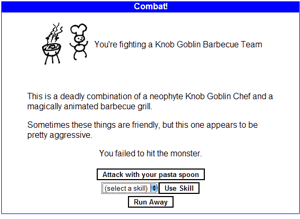
kol.gifTired of formulaic Tolkienesque derivatives? Finished with Final Fantasy? Wheel of Time have you going in circles? Write you own best selling fantasy novel with these invaluable tips, such as, “All fantasy worlds are roughly square. i.e. the shape of the double page of a paperback.” Hey, if Brian Herbert can do it, so can you!

While you’re waiting for “The Grue-ing Adventure” to get back from the publisher’s, dig into the web-based RPG Kingdom of Loathing. Choose one of six awesome character classes, such as the Disco Bandit or Turtle Tamer, and embark on a quest to loot the planet for Meat and obtain exciting items, such as the Asparagus Knife and eXtreme Mittens.

I’m quanta8, a Level 3 Pastamancer (Noodle Neophyte). See you there.

Mail and lickr

I got a GMail invite. Personally I’m a bit ambivalent about it all. I’m interested in the concept of using GMail is a cyber life recorder, but the practical me just sighs and says, “Ho hum, another email account to manage. And a web-based one too.”

To be frank, I’d rather have a 1GB of webspace than a fatty mailbox. Then again, someone suggested that I could keep photos in there and manage them via Organizr, so the GMail account may come in handy after all.

All in all, both apps seem fairly nice to work with. Some have suggested they have transcended to a level of usability that was once the sole domain of desktop apps. This means the Network Computer is closer than ever.

Aside: Have you noticed that if you type in “alcohol” in Google your first search result is not about the devil’s milk we all enjoy responsibly from time to time, but the Alcohol 120% CD copying software. Goes to show, geeks would rather rip music than imbibe.