Lunch on Tuesday

I really should write more about my personal life. It’s just not very interesting, in my opinion.

Had lunch with the ol’ university gang at Duke of Westminster last Tuesday. The Duke isn’t my first choice because I just don’t feel inspired by their menu, but it happened anyway. It’s the closest restaurant to Frenchy’s work. Being in the basement of First Canadian Place, the Duke is also noted for being a giant dead zone; cellphones don’t work. On Tuesday, I met a businessman outside shivering and fiddling with his Blackberry.

The chuckle du jour: businessmen in front of us in line asking the maitre’d, “Can we have a spot that’s quiet?” Considering that the Duke’s mean sound level is probably 40dBA, they should have went to McDonald’s instead. Why, they could then even surf the Internet wirelessly on their laptops!

Over a surprisingly moist chicken pot pie, baked beans and buttered peas, BigPoppa regaled us with his recent pilgrimages to the Big Apple. His employer has been shipping him out there three weeks out of four for the past couple months. It has become an excellent opportunity to bulk up on Starwood membership points and build an impressive hotel shampoo collection. In his recent trip, he checked into an Executive Club King room at the Westin New York at Times Square. It comes with a “Heavenly BathSM” – a specially designed bathtub with two showerheads and an arched shower curtain rod so your right elbow and the curtain will never touch, ever again.

But travelling is not all fun, games and chocolates on your pillow. It can be lonely. It’s just you, in a big hotel room in the big city, eating by yourself. That’s why I brought Silverlotus with me on my trips to Toronto.
Let’s get visual

Representing data in visual flows and maps can make you assess large volumes of info quickly, and even let’s you discern patterns and correlations you wouldn’t normally be able to see.

Visualize current events with Newsmap – Populates Google News articles in a visual landscape. The more sources reporting on a particular topic or event, the larger it appears on the map. It’s interesting to compare Canadian news sources vs. USA news sources; according to Newsmap, the US media covers over five times as much US national stories than Canadian media covers Canadian stories. The major headline in Canada is a world story – “Iraqi cleric condemns mutilation of American’s bodies”. The biggest headline in the US is “9/11 commission looking into Clinton document request”.

Visualize fiction literature with Gnooks – Summarizes readerships of various authors in a visual chart. The closer two authors are to each other, the more readers they share (and by extension, novels penned by these authors may share common themes, proses or concepts). William Gibson (Neuromancer) is located very close to Frank Herbert(Dune), but not as closely as Neil Stephenson (Cryptonomicon). Surprisingly, fans of Gibson’s sleek, stylish cyberpunk also enjoy and H.G. Wells (War of the Worlds) and his dark turn-of-the-century sci-fi.

Visualize music with musicplasma – Connects music across genre boundaries via music artists. Who knew that most people who enjoy listening to U2 also like Dido.

Going random

1) So my boss and I are driving to a meeting, and some twit cuts us off near Yorkville. My boss swore, threw his hands in the air, and exclaimed, “I wish I had a gun!”

“No you don’t,” I replied evenly.
“I wish I had a gun and diplomatic immunity!” he replied.

He will make a fine lawyer. 🙂

2) Sometimes arranging to have dinner with Juice is like directing a Broadway musical. Wish I remembered that my cellphone supported three-way calling. It was a good dinner in Chinatown though.

3) One of the most upstanding, long running April Fool’s jokes: Bungie’s Pimps at Sea.

Touch type

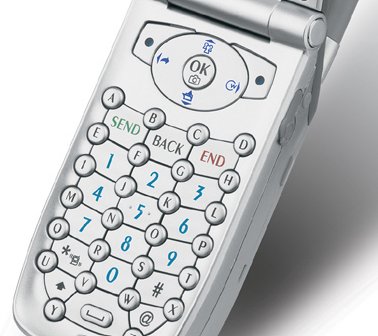
telus_fastap_02.jpgAs anyone who’s ever tried to type a name into their cellphone’s addressbook knows, T9 is a joke. It is about as coherent as a wino on a Saturday night. Fastap, a special keypad developed by Digit Wireless, should make text messaging less of a pain to use. Telus Mobility, partnered with LG, will be the first wireless provider in the world to offer a Fastap-equipped phone to its subscribers. The fast time-to-market is partly thanks to Telus investing in Digit Wireless.

Picture from infoSync World

Leave a message. Beep.

Wow, where has USA Today been for the past five years? They trumpet the discovery of clever IM away messages like capri pants. Sorry McPaper, people have been writing silly away messages since the invention of the answering machine.

In my freshman year, my roommate and I recorded fascinating answering machine messages. Once he played “Flying Bee” on his violin as I frantically claimed we were being chased by bats. We eventually stopped doing it due to time constraints and the fact we were looking for summer employment. Recruiters who arrived at a recording proclaiming we were some New Age meditation centre rarely left messages nor called back afterwards.

Bomberman once wrote in his ICQ Away message: “I am meditating with Tibetan monks. I’ll get back to you when I am no longer one with the universe.”

During one summer, I wrote “Be back in five. Sticking my head in the freezer. Ahhhhhh.”

Just wait until USA Today finds out that people leave funny bylines in their MSN Messenger Display Names. I expect an enthusiastic article sometime around 2007.

Another love TCO

There are a handful of Windows vs. Linux TCO studies available. IBM and Opensource.org usually cites this one by the Robert Frances Group that was published in September 2002.

The rest of them, unfortunately, are all bankrolled by Microsoft. In the same way cancer studies funded by the tobacco industry always seem to put cigarettes in a favourable light, the majority of IT staff take these MS-funded TCO studies with a chunk of salt. So when Yankee Group and Sunbelt Software claimed to have released the first-ever independent Windows TCO vs. Linux TCO study, I was intrigued.

Even more intriguing was its conclusion: that Windows TCO was less for large corporations that have predominantly Windows-based, and more for smaller startup firms. These questions immediately come to mind:

Possible Conflict of Interest

  • Sunbelt Software is a Microsoft Gold Certified Partner whose entire revenue is derived from selling Windows NT/2000/XP tools and utilities.
  • Laura Didio, the primary Yankee analyst of this study, is infamously known as having championed SCO’s legal battles against IBM and the Linux community.
  • The survey involved 1,000 IT administrators – however, the sample selection was not random. The survey was given to subscribers to W2KNews, a Windows NT/2000 newsletter published by Sunbelt.

Study Methodology

  • The study’s control case is of a company already running Windows systems. It would be logical to assume that sticking with Windows would be less expensive than migrating to another vendor, whoever that might be. After all, it is always cheaper to keep your existing car, even if it’s a lemon, than going out and buying another one.

    Aside: In a way, this point inadvertently highlights the lack of interoperability within MS products; companies who are Windows shops are often “locked-in” with licensing contracts and sunk costs which leaves them helpless in negotiating pricing and support.

  • No analysis on upgrade costs or marginal costs to scale, nor to the soft costs of running damage control for viruses and security exploits.

The paperback continuum

Remember Penny’s “computer book” in the ’80’s cartoon Inspector Gadget? It was a PDA, cellphone, tricorder and hacking tool all in one, and consisted of paper-like colour touchscreen pages bound into a hardcover tome. How I wish for an ebook like that!

Alas, the ebooks of today have not taken the world – or word – by storm.

At least one ebook company, Waterfront Media, has cleverly differentiated its products by harnessing ebooks’ greatest strength – their interactivity. Turning their ebooks into 1414.jpghypermedia generates value-add that would be impossible with content on paper. For example, Waterfront’s diet books have shopping list generators and integrated access to their support forum website.

On the other front, Sony will be releasing the Librie, the first ever portable e-ink ebook reader. Based on Phillip’s e-ink technology, the Librie can hold 500 texts and display them on a 170dpi, 800×600 greyscale screen. While still too rich for my blood, ebooks need ultra-high resolution, anti-reflective displays to match the quality of print and paper, and initiatives such as this and IBM’s Reontgen 200dpi LCD display brings us one step closer to that goal.

The tainting effect, explained

When lawyers talk about the GNU General Public License, they talk about it having a “viral nature” or “tainting effect”, which isn’t very flattering. Executives are often left with the impression that the GPL is like a litigious leper, spoiling all intellectual property it touches and turning it into free stuff. Executives don’t like their stuff being free. They want people to pay for stuff.

In what is possibly the clearest clarification of GPL’s tainting effect is tackled by a posting written by paralegal Pamela Jones of Groklaw fame. Basically, yes, if you are a programmer and you use GNU licensed code in a program you are writing and releasing to the public, your program must be released under the GNU GPL as well. This means also releasing the program’s source code.

For example, you are free to sell a GPL’ed program for fun and profit. The caveat is, you have to provide the source code, and you cannot stop someone else from selling the same thing.

The GPL is, however, non-exclusive. If you are the sole creator of a program, you can provide a free GPL version of your program + source code, and then turn around and sell an enhanced “Deluxe” version under a commercial license. And you don’t have to give out your code for the Deluxe version.

The tainting effect is misunderstood, sometimes even by intellectual property management. It actually only applies to specific cases of program distribution. For example, if you are just user of a GPL’ed program, the GPL does nothing to restrict your movements. You can copy or sell it as much as you please. That is the beauty of public licenses; while commercial EULAs are full of “do nots”, public licenses let users do whatever they wish.

The tainting effect only manifests itself if you, as a programmer, physically merge your code with that of source code licensed under the GPL. A proprietary program and GPL’ed program can sit on the same CD, without any fear of tainting. This is known as “aggregation”. A proprietary program can also intimately interact with a GPL’ed program, and retain its IP rights. For example, videocard drivers, traditionally chockfull of highly sensitive code, can run on Linux without fear of having their source code revealed.

You can even take a GPL program back to your organization, modify it, and be under no obligation to make your changes public, as long as you keep everything internal. You would only have to apply the GPL rules of distribution should you decide to distribute or sell the compiled code to the world at large.

In any case, even if your product has been tainted with GPL code, it does not mean you’re doomed. You still have a way out. You can consult with the Free Software Foundation, remove the GPL code and replace it with your own, and continue on your merry way. The FSF are often quite accomodating as long as your organization honestly made a mistake.

Incidentally, while about 85% of all open source software are licensed under the GPL, including Linux and The Gimp (which released Version 2.0 this week!), the GNU GPL is by no means the end-all and be-all of public licensing. Many open source programs such as Mozilla, OpenOffice and Apache operate under their own specially-designed public licenses which offer substantially more protection to a developer’s IP rights.

Shameless Linux plug

Take a gander at Knoppix, an unique Linux distribution from Loadux.com. Knoppix Linux is a fully functional, bootable Linux OS that runs right off the CD. That’s right – no hard drive installation is required. It even comes with other fully functional open source goodies: the Konqueror and Mozilla web browsers, the XMMS media player and OpenOffice. It’s great if you want to test drive Linux hassle-free, or a maintenance tool for fixing messed up Windows systems. It’s free to keep, use and copy.

One Groklaw reader also points out Knoppix could even be the key to a guerilla marketing campaign for Linux and OSS.