Personal Displays of Affection

Dana fantasizes about his idea of a perfect PDA – fortunately for him, most of his wishes are already commercially available (and the laser keyboard is coming soon).

I hate PDAs. There is something banal about using a plastic stick to scratch tiny characters onto a small patch of plastic while peering into a murky plastic screen just doesn’t grab me.

What I want, does not yet exist:

  1. Ultra-high contrast, ultra-high resolution true colour screen
  2. Make that a flexible e-paper screen
  3. Or a projector screen. I’m not picky.
  4. WiMax or FireWireless access, or some other newfangled broadband wireless standard
  5. User design is built around a portable web browser
  6. Voice recognition; so I can just say “Weather for Toronto” and go straight to that webpage
  7. Open document format – because I don’t feel like having to pay for some proprietary locked copy of Alice in Wonderland, thank you

PDALive showed a concept of the PDA of 2010 by Popular Science. Yeah, that’s kinda what I’d like. Until then, I’m lugging this notepad with me. It doesn’t lose charge, and I can even use it as a coaster.

Cyberpunk come true

Weekly Read highlights Ray Kurzweil’s 2001 essay, The Law of Accelerating Returns. It’s a lengthy read, but it boils down to this: computational power is growing at an exponential rate while transistors are shrinking at an exponential rate. Socio-political trends such as education, ecommerce and GDP expenditures are also growing exponentially.

In light of these trends, Ray extrapolates that humankind will continue to advance technologically faster and faster; according to his math, for example, he predicts we will:

  1. Achieve one Human Brain capability for $1,000 in 2023.
  2. Achieve one Human Brain capability for one cent in 2037.
  3. Achieve one Human Race capability for $1,000 in 2049.
  4. Achieve one Human Race capability for one cent in 2059.

Quite the aggressive timetable, you might say. Ray believes humanity will reach Vinge’s Singularity – a point where human innovation and intelligence will accelerate to a near-infinite pace!

The seemingly insane part of this is, Ray’s calculations indicate that we will reach this Singularity within our present lifetimes.

By the second half of this next century, there will be no clear distinction between human and machine intelligence. On the one hand, we will have biological brains vastly expanded through distributed nanobot-based implants. On the other hand, we will have fully nonbiological brains that are copies of human brains, albeit also vastly extended.

I am reminded by the current trend in Olympic records. That is, at every Olympics, athletes have become stronger and faster and invariably break existing records. Optimists believe this trend will continue endlessly, and someday humans will run the 100m sprint in less than a second. Others believe that record-breaking will begin to slow down and stop due to some physical limitation the human body (and human health sciences) have yet to reach.

Ray’s hypothesis has merit assuming:

  • The accelerating rate of energy research exceeds that of the rate of resource consumption: In other words, we discover alternative energy sources to consume before we exhaust our current ones.
  • The accelerating rate of intelligence exceeds the rate of weapon research: That is, when we have the capability to create the Bomb to End All Bombs, we’ll have the intelligence not to use it and blow us all up.
  • Financial incentives for innovation increases in a locking step with said innovative breakthroughs. Gotta keep the economy flowing.

Even Ray admits there can’t be infinite growth in a finite universe: he sees this trend continuing “at least until we ‘saturate’ the Universe with the intelligence of our human-machine civilization, but that will not be a limit in this coming century.”

How do we know we won’t hit some inverse Condon curve of innovation down the line, and human achievement will stagnate? I want to believe him, though.

That’s why they call it market *share*

PCWorld cites an IDC study where Microsoft operating system market will drop to 58% by 2007. Neowin members mostly responded derisively to these findings.

Why is change so hard to stomach? The article is may be optimistic, but by no means misinformed. Windows has a strangehold on the PC market right now, but it’s not so in other faster growing fields – game consoles, PDAs, smartphones, Internet appliances, etc. All these devices need operating systems, and they are getting more powerful and versatile every day. There is a growing shift in demand from PCs to these convergent devices.

MS has been trying to gain footholds into these emergent markets via the Xbox, WebTV, SPOT Watch and a bazillion Windows XP branded OSs – Media Centre, TabletPC, PocketPC, Embedded – but are no means the dominant player in any of these markets, even after years of effort. They’re running up against companies that are equally large and powerful and hungry and smart – not to mention the modularity of Linux, which has appeared in everything from TiVo players to Volvo dashboards.

Of course, it’s not wise to discount MS out of hand – they have a lot of smart cookies working there – but it won’t be an easy battle for them.

Many people still cannot take portable convergent devices seriously – sort of how minicomputer users refused to take personal microcomputers seriously when they appeared in the early 1980’s.

Eventually wireless, whether it’s Wi-Fi or 3G or WiMax or its grandchildren – will become so advanced that network access will be ubiquituous and network bandwidth will approach system bus speeds. When that happens, AGP, PCI and USB will be replaced with pure IP, and we’ll never have to fiddle with DVD-Rs and flash memory cards again. A future MP3 player could access your music from your home PC’s file storage as fast as it was on your person. A portable videogame player could outsource its 3D graphics work to your PC’s videocard while remaining inexpensive, small and light.

There’s art, and then there’s masterworks

Some works of art separates the boys from the men. This entry is dedicated to the demigods whose work has no equal.

rc_sunset0000.jpg pno0001.jpg

.kkrieger, chapter I
.theprodukkt is a talented demoscene group that have released their first FPS game. It has bumpmapping, particle effects, realtime shadows and dynamic lighting and supports DirectX’s pixel shader 1.3 effects. Oh, and it’s also only 96 KB. That’s right, they’ve crammed an AI, 3D rendering engine, soundtrack and textures in a file that’s smaller than this screenshot. You can strafe, and have access to five weapons. It is quite the memory hog, however – I had to turn off my AA and AF on my Radeon 9800 Pro to get an acceptable framerate – but that was a small price to pay to play an FPS that’s as small as Tetris.

HL-Rally Beta 1.0
And finally, one of the most anticipated and ambitious Half-Life modifications has finally landed, and thy name is HL-Rally. Five years ago, the HL-Rally team had the crazy notion to build a racing game with the Half-Life engine. In an engine designed for a first-person shooter, they’ve designed giant winding tracks with breathtaking vistas. Sure, the graphics are dated and there’s a lot of bugs, but you can’t just help but love it for its sheer spunk. You can even make your little car drift around corners, and the built-in music player lets you burn rubber to your MP3s, or even Internet radio.

illusorysidebox.jpg

A bit of urban art: incredibly decorated utility boxes. They look like JWIs (Junction Wire Interfaces), aka telephone crossboxes, to me.

A nice ring to it

Thanks to cellphones with polyphonic sound processors, the world has re-embraced the MIDI. The problem is, most songs sound appalling in MIDI form – although this doesn’t stop people from sticking it on their cellphones.

MIDIs have a limited range, which is why I believe people should stick to polyphonic tones of the following two music genres – techno and Super Nintendo music. Let’s be honest, no one wants to hear Beethoven’s Ninth squawking on your phone in 16-bit beeps and bleeps.

What’s on my phone:
With Caller ID: Final Fantasy – Prelude (aka “the crystal cave music”)
No Caller ID: Chrono Trigger – Fragment of a Dream

I’ve never actually played any of these games, but the tones sound nice as MIDIs. No overly high pitched notes, and no aggressive melodies.

Moore’s Law 2 Turbo

Just another brainwave regarding my last post: Since the IC market is suffering from performance oversupply at this point, chipmakers will fortunately embrace this 4th axis.

Why? Because the market now demands it. For a long time, consumers just wanted faster chips, efficiency be damned. This is why Intel was such a big backer of multimedia with their WebOutfitter program and digital cameras back in the mid-’90s; multimedia require computers with beefy microprocessors.

Now, the desktop computer market is experiencing a lull. My mom has a Duron 800, and she’s perfectly happy with it. The market has reached performance oversupply. Now the IC manufacturers will have to increase system efficiency in their attempts to differentiate their products from each other, as well as to gain traction in the one value market that is still growing: embedded portable devices. Now you can see why Intel is touting Centrino’s power saving and wireless features and canning their MHz nomenclature.

Any intelligent fool can make things bigger, more complex, and more violent. It takes a touch of genius – and a lot of courage – to move in the opposite direction.

– Albert Einstein

I fought the law and the law won

Wired proposes a Moore’s Second Law: Overall net efficiency of any electronic system will double every 24 months.

I’m fine with that. There is a tech culture to be faster or smaller or cheaper – but not necessarily better. It’s easy to sustain existing technology. So it’s a fair criticism to say not enough attention is made to making technology more efficient – use less electricity, generate less heat, produce less waste. Today’s CPUs use more electricity than a heat lamp, and belch out so much heat that they need aluminum heatsinks the size of your fist. Consumers are reacting against loud, noisy fans in PCs.

The problem with Wired’s logic is that they fundamentally misunderstand what Moore’s Law is all about. It’s not actually a law; it’s merely an observation. In Gordon Moore’s “legendary paper”, “Cramming more components onto integrated circuits,” Moore makes several observations. Poignantly, it features a cartoon illustration of a vendor stand hawking “Handy Home Computers” the size of iPods. This is quite forward-thinking, considering this article was published on April 19th, 1965.

Moore simply points out that, all things being equal, the number of components per integrated circuit will double in magnitude for “at least ten years”. Manufacturing cost will decrease as well. Moore also notes that this progression can only be considered true with silicon semi-conductors with adequate cooling technology. Moore’s Law, goes out the window when considering the implications of biotech or quantum computing, for instance.

The paper continues on by discussing cost reduction. One way is to “amortize the engineering over several identical items”. Intel and other chip fabs already do this via speed binning. The second way is to introduce new design automation procedures; this has been realized with CAD.

Finally, the third suggested method is the building of “large systems out of smaller functions” and this is what Wired is suggesting should be Moore’s Second Law on efficiency. But I see it as a call for modularization, not efficiency. It is already happening now, with object oriented design and open standards.

What I do agree with is introducing a fourth axis to chip performance. The first three axes are speed, form factor and price. The fourth is overal system efficiency.

Let’s get visual

Representing data in visual flows and maps can make you assess large volumes of info quickly, and even let’s you discern patterns and correlations you wouldn’t normally be able to see.

Visualize current events with Newsmap – Populates Google News articles in a visual landscape. The more sources reporting on a particular topic or event, the larger it appears on the map. It’s interesting to compare Canadian news sources vs. USA news sources; according to Newsmap, the US media covers over five times as much US national stories than Canadian media covers Canadian stories. The major headline in Canada is a world story – “Iraqi cleric condemns mutilation of American’s bodies”. The biggest headline in the US is “9/11 commission looking into Clinton document request”.

Visualize fiction literature with Gnooks – Summarizes readerships of various authors in a visual chart. The closer two authors are to each other, the more readers they share (and by extension, novels penned by these authors may share common themes, proses or concepts). William Gibson (Neuromancer) is located very close to Frank Herbert(Dune), but not as closely as Neil Stephenson (Cryptonomicon). Surprisingly, fans of Gibson’s sleek, stylish cyberpunk also enjoy and H.G. Wells (War of the Worlds) and his dark turn-of-the-century sci-fi.

Visualize music with musicplasma – Connects music across genre boundaries via music artists. Who knew that most people who enjoy listening to U2 also like Dido.

Touch type

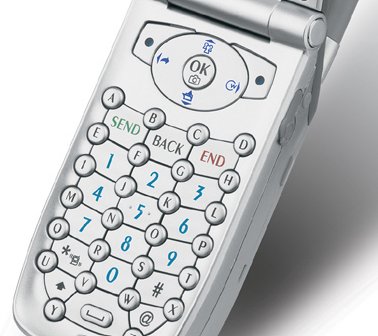
telus_fastap_02.jpgAs anyone who’s ever tried to type a name into their cellphone’s addressbook knows, T9 is a joke. It is about as coherent as a wino on a Saturday night. Fastap, a special keypad developed by Digit Wireless, should make text messaging less of a pain to use. Telus Mobility, partnered with LG, will be the first wireless provider in the world to offer a Fastap-equipped phone to its subscribers. The fast time-to-market is partly thanks to Telus investing in Digit Wireless.

Picture from infoSync World