
Toronto the body double

toyotamatrix.jpgI always get a kick out of seeing shots of Toronto in popular media. From Short Circuit 2 to Good Will Hunting, films have used Toronto as a kind of body double for grander places. For example, the historical landmark of Casa Loma sat in as the X-Men‘s school for mutants.

My latest sighting is from the recent Toyota Matrix movie trailer (Quicktime movie is here).

In the beginning the cars race under the Gardiner Expressway and then head north through the Bay St. underpass toward Union Station. The “anime” is being shown on multimedia billboards at Yonge and Dundas, across from the Eaton Centre. Another shot shows one of the spinning neon records from the “Sam the Record Man” on Yonge Street. At the very end you see the BCE Place in the skyline.

It’s very surreal because the streets are deserted and all the store signage has been edited out, but it’s TO alright.

Only months before, moviegoers saw Milla Jovovich in Resident Evil: Apocalypse run down the Toronto City Hall before it was blown up with (computer generated) bombs. The movie poster also features the uniquely steepled roof of the BCE Place tower on the righthand side.

I’m not sure if it’s that comforting flash of recognition, or pride that my hometown is being seen to millions of people and they won’t even realize it. Or the silent satisfaction of being able to see through the disguise of an American city, a disguise spawned from the curious Hollywood belief that Americans won’t go watch anything that indicates there is civilized life outside the USA.

Pillow type

godfatherhorsehead1.jpg I love hugging Silverlotus’s pillow. It’s warm and cuddly, and seldomly asks for jewellery. And lo, it is not I who enjoys a good pillow now and then:
1. Cool heads will always prevail with the Chillow, a gel-and-water based pillow that wicks heat away from your head, giving a pleasantly cool surface to sleep on all through the night. Just add lukewarm water to it once and off to the sheep counting races you go.

2. The Godfather buffs can enjoy a cute plush pillow shaped like a horse’s head. Hopefully it’ll be the closest you’ll get to sleeping with the fishes.

3. I suppose turnabout is fair play: the Japanese are replacing men everywhere with perfect snuggable facsimiles of our arms and torsos. And if the Boyfriend Arm Pillow doesn’t depress you, get this – it even has a vibrating alarm.

Been there, slayed that

kol.gifTired of formulaic Tolkienesque derivatives? Finished with Final Fantasy? Wheel of Time have you going in circles? Write you own best selling fantasy novel with these invaluable tips, such as, “All fantasy worlds are roughly square. i.e. the shape of the double page of a paperback.” Hey, if Brian Herbert can do it, so can you!

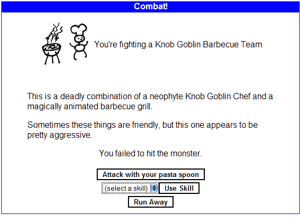
While you’re waiting for “The Grue-ing Adventure” to get back from the publisher’s, dig into the web-based RPG Kingdom of Loathing. Choose one of six awesome character classes, such as the Disco Bandit or Turtle Tamer, and embark on a quest to loot the planet for Meat and obtain exciting items, such as the Asparagus Knife and eXtreme Mittens.

I’m quanta8, a Level 3 Pastamancer (Noodle Neophyte). See you there.

For the game…oh yeah and the money

The Canadian Olympics Committee is pretty hardnosed about their brand. They’re even complaining about sports-themed advertisements run by companies that are not Olympic sponsors.

Bell Canada, as a bonafide Olympic sponsor itself, has one amusing rule governing the Olympic rings logo. The COC logo (Olympic rings with a red maple leaf) cannot be shown in any public advert that prominently features a The phones of Samsung_web.jpg cellular phone not manufactured by Samsung, who is also a registered Olympics sponsor. If the image of said non-Samsung phone is small and has its company logo removed, it’s okay.

As Boing Boing pointed out, “Companies sponsor your games because they’re important and lots of people watch them, not because they can be assured that Olympic venues will be swept clean of rival logos.”

Might be a moot point anyway. Apparently live Olympic attendance is very low at the moment. Maybe they had to refuse entry to too many folks carrying non-Dasani bottles of water. The problem is being solved by giving away free tickets, which is a common solution for any undersold public event.

The Samsung-Bell pact did bring about a really nice phone, though. Silverlotus got a “Samsung A660 Olympic Edition” flip phone (left), and it’s better than my A500 (in the centre) in almost every way – smaller, lighter, cheaper, better graphics, better sound, better voice recognition – but lacks an external LCD screen. It also makes a pretty tinkling noise when you open or close it.

She plans to get some acrylic paint and sandpaper to remove that COC logo in due course.

Perhaps video didn’t kill the radio star

John Dvorak doesn’t like Clayton Christensen’s The Innovator’s Dilemma very much. In fact, he calls it “the biggest crock of the new millennium“, which is pretty damning in a clairvoyant way, considering we still have 996 years to go, and in a temporal way, considering “Innovator’s Dilemma” was published in 1997. His curt behaviour toward disagreeing commentators doesn’t help his case.

James V. McGee suspects Dvorak hasn’t actually read the book, while Corante’s Renee Hopkins Callahan diplomatically suggests that perhaps it’s not the concept he’s against, merely the surrounding hype.

Both take Dvorak to task on his assertion that “there is no such thing as disruptive technology”, which is demonstrably false. Christensen defines disruptive innovations as follows:

  1. They initially appear as inferior alternatives to the current incumbent product or service. This inferiority may be a higher price or poorer performance.
  2. They establish some low-end niche market only slightly related to the disruptee.
  3. Technical or social change begins to negate their inferiority. Price gradually goes down, performance slowly improves.
  4. Suddenly said disruptive technology crosses over and becomes a worthy challenger in the incumbent’s market. At this point, the customer sees the disruptor and disruptee to have feature parity, with the disruptor having greater value.
  5. Disruptee customer demand drops, and the incumbent innovation is wiped out virtually overnight. The requisite companies that refuse to change usually meet the same fate.

Seth Godin sums up disruption as a point where “incremental band aid improvements cease to pay off and instead, wholesale replacement occurs“.

Dvorak uses Linux vs. Microsoft to prove how disruptive technology is hooey; despite Linux’s disruptiveness, he argues, MS is richer and bigger than ever. Which is true, if a bit disengenious; as we all know, the fat lady has yet to sing in that opera.

In hindsight, we can all think of disruptive technologies. Cellphones are killing off landlines, satellite phones and airplane phones. Digital photography made Polaroid extinct overnight. Discount airlines are taking the air travel market by storm.

The innovator’s dilemma is that seldomly do companies see the danger and react before they’re about to be T-boned.

Naturally, disruption truly works when all things are equal. If a product or its management just plain sucks, it will fail no matter what. Ergo, incumbents have used tactics such as aggressive litigation and marketing to kill off smaller disruptive hopefuls.

One thing I do agree, however, is that disruptive innovation is not a cure-all. Business, like dieting, is full of faddish theories. The term will be exploited by marketers to be trendy, by executives to defer accountability for their failures, and by IT pundits like Dvorak and I trying to fill up the Internet.

Mixed clouds of the creative mind

“Acquire steelier knives and/or less resolute beast”

John Moe’s Changes to the Hotel California, Made in Response to Mr. Henley’s Recent Complaint

“Still, trusting Microsoft to handle your money seems a little like hiring Oprah to guard the Oreos. One day you’ll wake up to find nothing but crumbs.”

Robert X. Cringely on the how online Passport glitches prevent people from even loading Microsoft Money 2004, Posted on Categories everything1 Comment on Mixed clouds of the creative mind

Critical Thinking: How to talk like a politician

Take a gander at Conversational Terrorism, a selection of bon-mot assaults and oratory tricks to siderail a topic. And then don’t do them.

“I would like to answer your question directly, but considering your past reactions / ability to cope with the truth / emotional instability, I feel that to do so would be a disservice to you at this time.” [Other person gets (justifiably) upset.] “See, what did I tell you. You are flying off the handle already!”