High(speed) society

It is no surprise that as the Internet has entrenched itself in the lives of regular folks all around the world in the past nine years, people are spending more of their time and money online.

Communities of netizens has essentially become a brand new society – a new society of digerati. In the end, the net is all about communication, and as it evolves, it will become a conduit for communicating with people, and so-called social networking technologies will become in demand. The decline in corporate travel budgets doesn’t hurt.

Currently, we have email, instant messengers, forums and webcams. We have chatrooms, blogs, wikis, and even virtual worlds. People get married online. But netizens still lack a way of being truly interactive, cohesive communities.

socialmap.gifMicrosoft Research has been pretty busy this year trying to tackle this problem. Their first jab at it was a P2P app called Threedegrees that allowed desktop communities to share music and communicate via MSN Messenger. Threedegrees looks stillborn though since it doesn’t seem to have addressed the real social divide – although its juvenile interface and the fact it could knock out your Internet connection probably didn’t help.

Their second jab is via something called “Wallop“, but not very much is publicly known about it. Basically, by combining a bunch of collaborative tools such as photo sharing, document synchronization, profiling, blogging and RSS, they hope to allow information to be easily shared by online communities.

Some tools, such as the Social Map (aka MSR Connections), lets you visually manage relationships and identify points of knowledge transfer. This is astoundingly powerful stuff, because if you need to find someone or something, you can immediately zero in on who knows what.

It’s powerful because such software can allow people to interact in a natural social context, and information to aggregate and flow easily within a community. It’s a 24-hour electronic wine and cheese.

MS isn’t the only one interested, many other companies are pitching similar concepts. But it’s coming, whether it’s Microsoft or someone else that finally pulls it off.

Enter the Flash Killer?

“Sparkle” is a series of tools recently showcased as part of MS’s Windows Longhorn technology platform.

It will allow developers to make Flash-like effects from within Windows programs via Avalon’s vector-based graphical API. When you minimize a program in Mac OSX to the dock, it actually looks as if it gets sucked right into the dock. I think that’s the kind of effect we’re talking about.

But it also looks an awful lot like another vector-based animation tool – Macromedia Flash. Which is why some pundits are calling it the “Flashkiller”.

Right now it looks more like a rudimentary programmer’s SDK than something artsies will want to use to make their Christmas e-cards, but it should be interesting.

Macromedia – to be frank, their tools are overpriced, non-intuitive and haven’t really improved in the last three iterations. Their only real competition came from Adobe and maybe Java. I know, I’ve used them. But the work dang well, is all.

XAML is basically MS’s ripoff of Mozilla’s XUL (pronounced “Zool”), although it includes a few interesting new features. XUL is based on the XML metalanguage set. It is what makes Mozilla/Netscape 7 incredibly flexible; for example, you can even program games into Mozilla. Unlike XML it will be proprietary/closed source and closed platform. Again in a copycat case, the next-gen IE will run on XAML.

It beats working.

In a true testament of skill, Nobuya Chikada makes ports of Pac-Man and Space Invaders…to Microsoft Excel macros. Ingeniously, each spreadsheet cell is used as a pixel. Well, at least we now know VBA is good for something other than writing viruses.

Unfortunately, Pacellman only works in Excel 97 and Excel 2000. In that case, why not relive those days in the schoolyard playing Wario Land with David Winchurch’s thesis project – a Java applet Game Boy emulator?

Flash of the Day: Another Super Mario spoof, Barge of 1,000 Bullets.

Travelling light with file tokens

File attachments can really bog down a corporate network. It just takes one user to send a 5MB MPEG of a dancing hamster to his team to see how wasteful they can be. You end up with giant Outlook folders and gobbled-up bandwidth. It appears a company called Creo has an interesting idea – everytime you send attachments, the Creo Token software compresses and encrypts everything into a “bundle”, but then sends a “token” instead of the actual file. With the Creo Redeemer software, your recipient can cash in the token, which points to the sender’s file bundle still residing on the sender’s hard drive.

Personally, I think they could do even better – how about having the sender’s bundle uploaded to centrally accessible, fast file servers, say an internal one for internal communications, and an external one on the Internet for extra-office email? I think there could even be a business opportunity for someone to offer Internet “public storage” for tokened files. The server can be configured to automatically destroy all files which have had their tokens redeemed, or after a preset amount of time.

Then, there will be none of this hard drive snooping business going on.

Monkey see monkey do

WLH-PDC-IE.Download.Manager.gif

There was a leak of Windows Longhorn Build 4051, Microsoft’s next Windows OS, and Neowin and WinBETA have the scoop in it. And while the MSN Explorer-ish user interface (codenamed Aero) will most likely be reviewed and revised before Longhorn ships in 2005 (2006?), the features are very real.

The next Internet Explorer seems to have a lot of interesting features, such as a download manager (above), a pop-up blocker, and the ability to install “Add-ons”. Wow, they wouldn’t have been influenced by Mozilla’s Download Manager, popup-blocker or Extensions, would they?

Call the office

I was a beta tester for the recently-released Microsoft Office 2003 System. I was impressed with its stability, even in beta stage, although I have to raise doubts on the value-add between Office 2003 and its predecessors such as Office XP or even Office 2000. And then there is the open-source office suite, OpenOffice. There is no one single user feature that makes it a must-buy, although Outlook (Go Chris!) and a lot of the underpinnings have been overhauled, making it more enticing in corporate enterprise situations.

Shell remarked that MS is spending $150 milllion on an ad campaign. “I just saw a parade roll by with people in orange Office T-shirts (a band apparently), a motorcade and then 3 powerboats painted with Office 2003 logos…The band was kinda straggly and it was drizzling. They had all these Orange and Yello balloons in the soccer field (remember that) plus 50 ft high balloon men saying ‘Office 2003’ waving around in the rain. Kinda weird.”

The debutante of the Office package was undoubtedly Microsoft OneNote 2003, a cool virtual scrapbook designed to make Tablet PC users take down notes. It has often been called “Notepad of steroids”, although the ability for users to stick text blocks, images and audio clips haphazardly on a page makes it much more similar to PowerPoint in technique.

I wonder if it will actually be USEFUL in day to day life, though. After all, it’s just lets you create really sloppy notes, which you will sooner or later re-edit into Word, PowerPoint or email. It may be over-engineered. I know most people just use a blank Word document to “scribble” notes in, or use a Palm note taking program, like MEMOPlus. I use QuickNote for Mozilla, personally. While none of these things lack the versatility of OneNote’s search and organization features, they do take notes just fine.

Bizarrely, while OneNote goes under the Office 2003 banner, it is sold separately. Even stranger, the marketing geniuses decided to sell it for $199 US MSRP. It’s great note-taking software, but it’s still just note-taking software.

Perhaps I’m a bit jaded because I don’t have a Tablet PC. Only a Tablet PC can understand your handwriting as text, thanks to its “digital ink” support; a regular PC will only see JPEGs. Of course, Tablet PCs haven’t exactly been flying off the shelves. The number one issue is cost – you can get a notebook with twice the horsepower for half the price. A tablet manufacturer claims that the ridiculous prices are due to Microsoft charging way too much for Windows Tablet PC Edition. Second reason is speed, or lack thereof, thanks to their low voltage mobile Pentium IIIs running at 800MHz – 1GHz and sluggish integrated video.

Name game

Carnegie Mellon is using a different kind of engineering to improve image searches on the web – social engineering. Instead of writing fancy algorithms to catalog them JPEGs and GIFs, they are getting Internet users to label each image for them. How?? By making image labelling a game.

Brute force, inelegant, and quite brilliant. We’ve all heard of grid computing with PCs with idle CPU cycles – why not harness the minds of capable but bored Internet surfers?

When it rains binary it pours

On Tuesday, I downloaded a 700MB file off a P2P application in less than four hours. There were no lineups, and no interruptions.

I was using a program called BitTorrent, which offers many advantages over standard file distribution systems.

The Internet has always been plagued by a disproportional ratio of content downloaders and content distributors. In a way, it comes down to human laziness; it takes effort to create content and upload it, but it often takes only one mouse click to grab content and download it.

Before the Internet became popular, incessant downloaders who never offered their own content were known as leeches. To prevent leeching, many BBSs and FTP sites used login authentication and enforced download/upload ratios; for example, you had to upload 100KB for every 400KB you took from the community.

Today, the static and anonymous nature of web surfing has encouraged leeching. Hence, if you want a file, you often have to enter long wait queues ala FilePlanet, scrounge around for a link to a mirror copy which a good Samaritan decided to put up, and often tolerate extremely slow transfer rates. It has become so endemic that game developers often shy away from offering game demos on their own websites, for fear of server crashes and high bandwidth costs. There are too many hungry people, and not enough cooks.

BitTorrent combats this leech problem by attempting to enforce pareto efficiency. When one person provides content for download, people can link up by clicking on its Torrent announcement file. As these people download each byte, they also become content providers by sharing the partial file to others. The more downloaders that join this group or “swarm”, the more uploaders there are to download from. Users can download from multiple sources at once. A person with a generous upload rate is generally guaranteed a handsome download rate. Because supply increases with demand, you get a really scalable file transferring system.

While traditional P2P networks act like flea markets (some vendors, many consumers), BitTorrent acts like a swap meet. Downloaders cease to be leeches; they become peers.

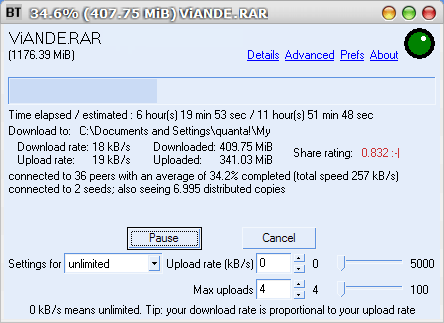
Unlike KaZaa, BitTorrent does not have its own special interface or network to join. Torrents are HTTP-based. You click on a file with a TORRENT extension on a website, and the BitTorrent client does the rest. I recommend TheSHAD0W’s Experimental BitTorrent Client, because it provides more statistics. As you can see, the UI still is pretty fugly, but more functional than the one from the original client.
bittorrent.gif

It resembles your browser’s download dialog box, but with some more information. Your “share rating” is the ratio of downloaded to uploaded bytes. According to this dialog, the swarm consisted of 36 peers or downloaders like myself. When a peer has completed their download 100%, they become a “seed” or a new downloadable source of the complete file. The user remains a seed, uploading the file to peers, until he/she closes their download box. According to the dialog, there were 2 complete seeds and at least 6 entire copies of the file spread amongst the peers. Therefore, even if these two seeds should disappear, the remaining peers should be able to complete their file transfers by swapping file fragments among themselves.

It is good form to keep the download window open until a ratio of 1 or higher is reached, even after you have finished your own download, to give back to the community what you have taken.

There are a few flaws, most which stem from the asymmetrical throughput of most broadband solutions. For DSL and cable users, their download speed is often many times larger than their upload. Therefore, one’s share ratio is often less than 1, and (due to laziness again) most people will close their download windows as quickly as possible to recover their lost upload throughput. Swarms often last a few days before dissipating, but if you arrived late to the party, there will be less seeds and you may not even be able to finish your own download. Since it is on a static webpage, the existence of a Torrent link does not guarantee there is a healthy swarm present, or any swarm at all.

However, it still beats waiting 2 hours in a queue of a traditional P2P app and spending another 15 hours downloading off a DSL user at 2KB/s, only to have the user log off halfway through.

Alternative power

Bioelectric generation: a bacterium that can turn sugar into electricity.

In the D drive currently: The XIII Multiplayer Demo. Screenshots do not do this cel-shaded shooter justice; it really does feel like you’re in the XIII comic book. Unfortunately, if the demo is any indication, Ubi needs to iron out a lot of bugs; the mouse sensitivity is still a bit off, the Join server screen has its “Previous Page/Next Page” controls obstructed by something else, and the demo has a tendency to crash.

The worst bug is the fact the game requires all players to press a key to begin another match; if one player has wandered away from their PC, no one can play.

Three-finger salute

The Indianapolis Star caught up with David Bradley, Ph.D the other week. Who’s he, you ask? Apparently, he’s the IBM engineer that gave the world “Ctrl-Alt-Del”, the three-key sequence that allowed users to reboot their crashed IBM PCs (and now, used for logging into Windows and opening Taskman).

Seems Bradley is on a crusade to promote careers in science and technology to the young ‘uns. A noble mission, alas I think he has his work cut out for him. We are a society that worships the hockey player, the singer, the artist. When you think “scientist”, you think of a balding white-haired man with a smoking purple potion in his lab coat and a DeLorean in his garage. An engineer is a problem solver, and a problem solved is out of sight, and out of sight means out of mind. Even though science can make you happy, apparently.

I remember having a homework assignment in Gr. 2 where I had to write down what I wanted to do when I grew up. I felt scared, because I had no idea. All the books I read depicted policemen, firefighters, pilots, artists, and writers. The closest approximations to sci-tech jobs were doctors and dentists.

I was in a fugue about this. Those vocations didn’t interest me in the slightest. Was that all there was in life? Chasing crooks or painting? I had to write “I don’t know”, while my classmates beamed that they wanted to be firefighters or nurses.

And then one day, my father brought home an Intel 286 PC, and my world was turned on its ear.