Name game

Carnegie Mellon is using a different kind of engineering to improve image searches on the web – social engineering. Instead of writing fancy algorithms to catalog them JPEGs and GIFs, they are getting Internet users to label each image for them. How?? By making image labelling a game.

Brute force, inelegant, and quite brilliant. We’ve all heard of grid computing with PCs with idle CPU cycles – why not harness the minds of capable but bored Internet surfers?

Vegas baby

Spent the last week in Las Vegas at the Circus Circus. The first interesting thing that struck me is that the Vegas we all know and fear is really just a four mile stretch of the Las Vegas Boulevard, nicknamed the Strip. It isn’t even in the city of Las Vegas – to save on taxes, those rambling supercasinos technically reside in Clark County, just west of the city limits.

Las Vegas is like a microcosmic parody of North America with its ubiquituous asphalt and manmade sanctuaries, lots of money changing hands, and big everything – big buildings, big people, and big stakes. I looked around the casinos – invariably they have low, blackened ceilings, and hundreds of people at hundreds of slot machines making terrific amounts of noise – and I see people with droopy eyelids and grim faces, sullen casino staff, cheap vinyl and cheap trinkets, and an endless array of blinking lights and electronic sounds at such a high magnitude that I could still hear the slots in my sleep.

Everyone sells. We had pizza delivery flyers crammed into our door. Taxis have three billboards on the roof and one attached to the trunk. Inside, there are two more mini-ads flanking a flatscreen playing commercials plus racks of coupon books. Everywhere you walk along the Strip, people are standing around, either trying to push a flyer for an “escort service” or a timeshare (this pitch unwaveringly begins with a “Are you free tonight?”).

Are these people really having fun, just interacting with a slot machine for hours on end? Do slots really just encourage sociopathy? It was kinda depressing.

Critical thinking: fallacies

The Nizkor Project has a special feature on their site: the complete text of Labossiere’s Fallacy Tutorial, which outlines 42 forms of errors in logical judgement. A good read, if only to improve your critical thinking. What I found particularily interesting is how politicians and public relations folk use many of these fallacies to boister their agendas.

Unfortunately, the Nizkor Project has probably seen quite a few fallacies in its day. Its site has been up since the birth of the web. Nizkor’s handlers are grizzled veterans in Internet flamewars, as the Nizkor Project is dedicated to refute Holocaust deniers and their claims with logical arguments and insurmountable truths.

When it rains binary it pours

On Tuesday, I downloaded a 700MB file off a P2P application in less than four hours. There were no lineups, and no interruptions.

I was using a program called BitTorrent, which offers many advantages over standard file distribution systems.

The Internet has always been plagued by a disproportional ratio of content downloaders and content distributors. In a way, it comes down to human laziness; it takes effort to create content and upload it, but it often takes only one mouse click to grab content and download it.

Before the Internet became popular, incessant downloaders who never offered their own content were known as leeches. To prevent leeching, many BBSs and FTP sites used login authentication and enforced download/upload ratios; for example, you had to upload 100KB for every 400KB you took from the community.

Today, the static and anonymous nature of web surfing has encouraged leeching. Hence, if you want a file, you often have to enter long wait queues ala FilePlanet, scrounge around for a link to a mirror copy which a good Samaritan decided to put up, and often tolerate extremely slow transfer rates. It has become so endemic that game developers often shy away from offering game demos on their own websites, for fear of server crashes and high bandwidth costs. There are too many hungry people, and not enough cooks.

BitTorrent combats this leech problem by attempting to enforce pareto efficiency. When one person provides content for download, people can link up by clicking on its Torrent announcement file. As these people download each byte, they also become content providers by sharing the partial file to others. The more downloaders that join this group or “swarm”, the more uploaders there are to download from. Users can download from multiple sources at once. A person with a generous upload rate is generally guaranteed a handsome download rate. Because supply increases with demand, you get a really scalable file transferring system.

While traditional P2P networks act like flea markets (some vendors, many consumers), BitTorrent acts like a swap meet. Downloaders cease to be leeches; they become peers.

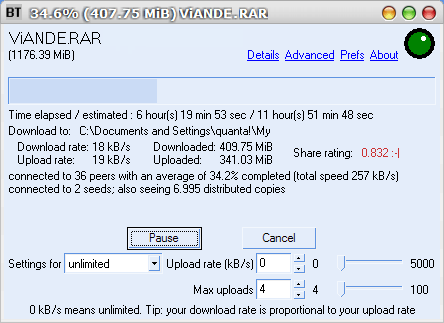
Unlike KaZaa, BitTorrent does not have its own special interface or network to join. Torrents are HTTP-based. You click on a file with a TORRENT extension on a website, and the BitTorrent client does the rest. I recommend TheSHAD0W’s Experimental BitTorrent Client, because it provides more statistics. As you can see, the UI still is pretty fugly, but more functional than the one from the original client.
bittorrent.gif

It resembles your browser’s download dialog box, but with some more information. Your “share rating” is the ratio of downloaded to uploaded bytes. According to this dialog, the swarm consisted of 36 peers or downloaders like myself. When a peer has completed their download 100%, they become a “seed” or a new downloadable source of the complete file. The user remains a seed, uploading the file to peers, until he/she closes their download box. According to the dialog, there were 2 complete seeds and at least 6 entire copies of the file spread amongst the peers. Therefore, even if these two seeds should disappear, the remaining peers should be able to complete their file transfers by swapping file fragments among themselves.

It is good form to keep the download window open until a ratio of 1 or higher is reached, even after you have finished your own download, to give back to the community what you have taken.

There are a few flaws, most which stem from the asymmetrical throughput of most broadband solutions. For DSL and cable users, their download speed is often many times larger than their upload. Therefore, one’s share ratio is often less than 1, and (due to laziness again) most people will close their download windows as quickly as possible to recover their lost upload throughput. Swarms often last a few days before dissipating, but if you arrived late to the party, there will be less seeds and you may not even be able to finish your own download. Since it is on a static webpage, the existence of a Torrent link does not guarantee there is a healthy swarm present, or any swarm at all.

However, it still beats waiting 2 hours in a queue of a traditional P2P app and spending another 15 hours downloading off a DSL user at 2KB/s, only to have the user log off halfway through.

Topleftpixel

A photo blog of my hometown, Toronto. Looks like it was taken from the Delta Chelsea Inn – or the very least, near Gerrard and Yonge St. The tall building half and inch from the left is the Metropolitan Hotel. The Greyhound station is on the left side of the street somewhere. An excellent picture site. Unfortunately, I only have a S110, so no time lapse trickery for me.

I can take pictures of my hotel room too though. How’s this:

Pizza Hut Express.jpg

I think my friend Dezza, currently in China, will appreciate this – over there going to Pizza Hut is like strutting into the Rosewater Supper Club. Over here, you can even order it for room service for less than $10.

Head over heels for heights

In 1998, a local high-school boy called Kenneth Au-Yeung was in the local paper. He was a choirboy, Grade A student, and the son of an upper-class family.

He was an avid volunteer and helped publish his school’s newspaper. One day, as a gag, he wrote some stupid placeholder text referring to convicted serial killer Paul Bernardo in one of the draft articles. Hey, you’re 17 years old, and just typing meaningless words like “Lorem ipsum” gets boring after a while.

The principal found out, got really upset, and decided to shake the newstaff up a bit. He even brought in a cop to freak them out.

Well, it worked. Shortly afterwards, Kenneth went to the Bloor St. viaduct, and jumped to his death twelve stories below.

The community was in shock. But I can understand where Kenneth was coming from – the stress of having to be absolutely perfect. I can also understand why the Bloor viaduct (only tourists call it it’s real name, the Prince Edward Viaduct) was such a suicide magnet. It has a great view of the CN Tower, plus the hilly ravines of the Don Valley. It’s easily accessible by subway. It was more elegant than a bottle of pills, less messy than a gunshot.

Bruce Cockburn wrote about it in the song “Anything Can Happen”. Michael Ondaatje wrote a novel about it.

Then again, it’s ridiculous. It overlooks the ten-lane Don Valley Parkway, and the dirty, narrow and shallow Don River. So you fall, break all your bones, and then get run over. Or fall, break all your bones on the river’s bottom, and then drown in sewage. Utter pointlessness.

While Kenneth’s school was absolved of all guilt, his death led to renewed action toward the construction of a suicide barrier on the viaduct. Personally, at the time, I was opposed to it. It’s going to be ugly, and people will just go back to razor blades and bathtubs.

However, I learned recently that our Bloor viaduct was the No. 2 jumping spot in North America, next to San Fran’s Golden Gate Bridge. In the case of the Golden Gate, it’s almost romantic – you’re just whisked away into the Pacific Ocean. Oh, and suffer terrible internal injuries before drowning and being eaten by jellyfish.

A design competition was held, a prof from Waterloo won, and $4 million later, the “Luminous Veil” was unveiled.

Personally, I hate it. The thin white rods don’t go with the bridge’s muscular black ironwork, and the supports are shaped like tilting crosses. So now you’re driving through a gauntlet of errie white crucifixes, looking like you’re on the road to Golgotha.

Then again, no one has jumped from the viaduct since the Golgotha barrier was erected. The locals are relieved that it isn’t totally ugly. Despite all of this, at least several folks have simply jumped from other bridges around town.

Some people, after so much trouble checking into this world, are just so eager to check out.

Alternative power

Bioelectric generation: a bacterium that can turn sugar into electricity.

In the D drive currently: The XIII Multiplayer Demo. Screenshots do not do this cel-shaded shooter justice; it really does feel like you’re in the XIII comic book. Unfortunately, if the demo is any indication, Ubi needs to iron out a lot of bugs; the mouse sensitivity is still a bit off, the Join server screen has its “Previous Page/Next Page” controls obstructed by something else, and the demo has a tendency to crash.

The worst bug is the fact the game requires all players to press a key to begin another match; if one player has wandered away from their PC, no one can play.

Saturday Flash

Pixel Parodies’ Rise Of The Mushroom Kingdom 2 – Luigi and the Mushroom people wage warfare on the Koopas to avenge Mario’s death.

Ubisoft’s Prince of Persia: The Sands of Time – A faithful recreation of the DOS classic. Unfortunately it’s just as frustrating.

Orisinal.com’s Cats – Keep the cats following the lead cat by hovering over them with your mouse.

In the D drive currently: I’ve been content on saving a few bucks and just playing demos. Is it just me or are demos getting bigger in size but shorter in gameplay? Tron 2.0 had only one level, and it was only a boss fight with a cranky cyber-snake. Homeworld 2 was better, although I’m a bit disappointed there have been few gameplay enhancements from the original; I think the expansion Homeworld: Cataclysm in 1999 was even more innovative. Excellent story, it appears though, by putting all your struggles in a theological context.

More power

Junkyard (Mega) Wars has been kind of lackluster this season. Seems that they have scrapped the whole educational and technical angle and replaced it with a contrived “Survivor”-style reality show, complete with fast scene cuts, bickering teammates and loud music. The hosts are complete technical neophytes; the male host is in fact a former contestant on Temptation Island 2, and spends most of his time yelling “Wow!” and “Awesome!” and smashing car windows.

So I’ve turned my attention to Discovery Channel’s Monster Garage. Now in its second season, it involves one hand-picked team of car and metalworking experts building a cool transforming vehicle. Today, I saw them turn a ’96 Chevy Impala SS (you know, the black supercharged version, before it turned into the bland Lumina clone it is today) into a zamboni. The trunk actually opens and a second set of steering controls pops out, and the car lowers the scraping blade to the ground. And it was painted a tight candy apple purple with bumping purple neon floor lights, which never hurts.

Three-finger salute

The Indianapolis Star caught up with David Bradley, Ph.D the other week. Who’s he, you ask? Apparently, he’s the IBM engineer that gave the world “Ctrl-Alt-Del”, the three-key sequence that allowed users to reboot their crashed IBM PCs (and now, used for logging into Windows and opening Taskman).

Seems Bradley is on a crusade to promote careers in science and technology to the young ‘uns. A noble mission, alas I think he has his work cut out for him. We are a society that worships the hockey player, the singer, the artist. When you think “scientist”, you think of a balding white-haired man with a smoking purple potion in his lab coat and a DeLorean in his garage. An engineer is a problem solver, and a problem solved is out of sight, and out of sight means out of mind. Even though science can make you happy, apparently.

I remember having a homework assignment in Gr. 2 where I had to write down what I wanted to do when I grew up. I felt scared, because I had no idea. All the books I read depicted policemen, firefighters, pilots, artists, and writers. The closest approximations to sci-tech jobs were doctors and dentists.

I was in a fugue about this. Those vocations didn’t interest me in the slightest. Was that all there was in life? Chasing crooks or painting? I had to write “I don’t know”, while my classmates beamed that they wanted to be firefighters or nurses.

And then one day, my father brought home an Intel 286 PC, and my world was turned on its ear.